
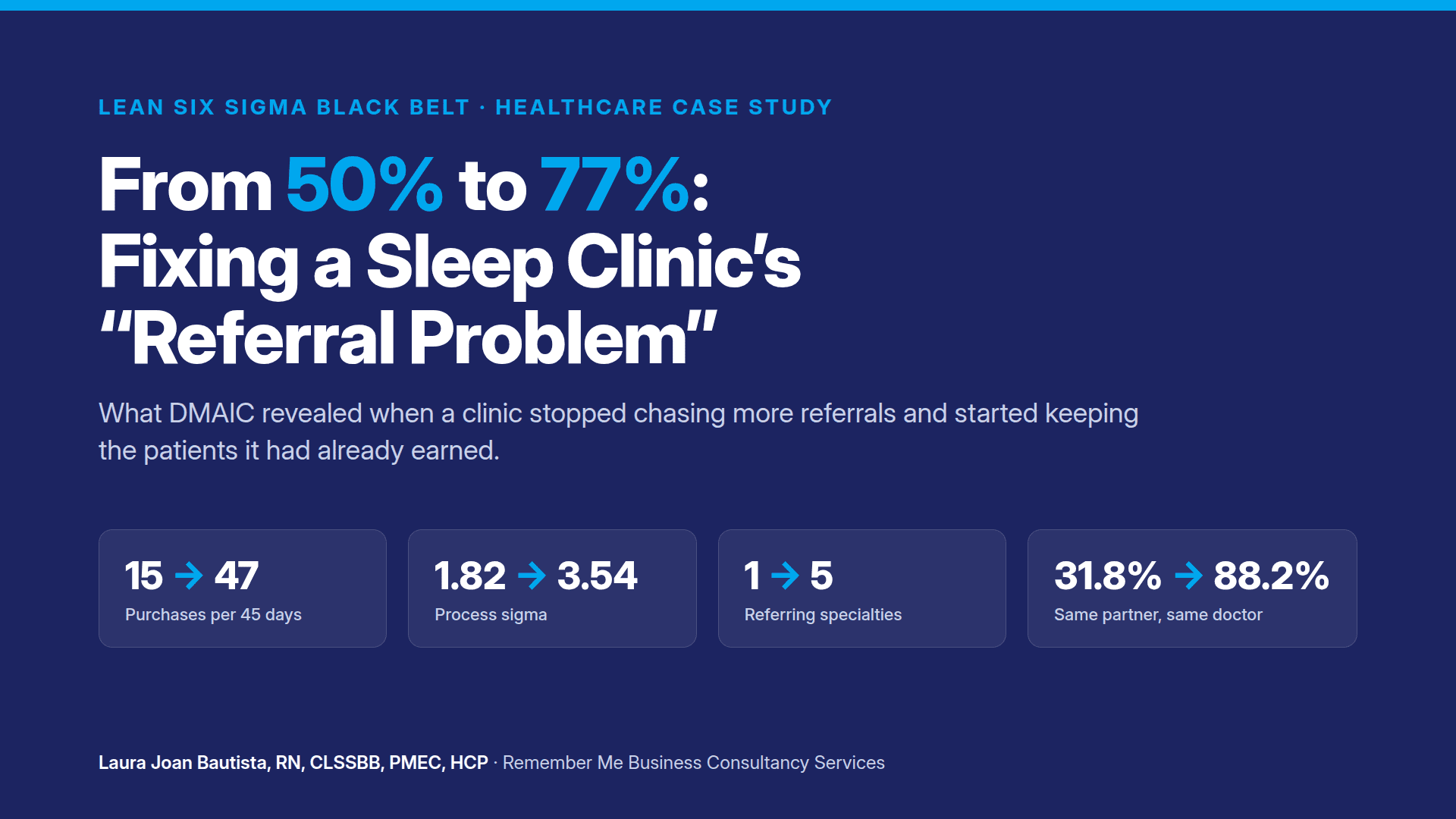
For three years, a Canadian sleep clinic believed it had a referral problem.
Referrals had plateaued. Sales had plateaued. The clinical team was doing physician outreach in the spare minutes between patient care, and the owners were understandably frustrated. The instinctive answer was the one most businesses reach for: we need more referrals.
When we measured it, the data told a different story. The clinic did need more referral sources, but that was only half of it. It was also losing patients it had already earned.
This is the story of my Lean Six Sigma Black Belt project, and why I believe healthcare operations need this discipline more than ever.
The Starting Point
We began with a clean baseline: one 45-day window before any intervention, compared against an equal 45-day window after. Same length, same clinic, same measurement rules. No cherry-picked months.
In the baseline window, the clinic received 30 referrals and closed 15 purchases, a 50% referral-to-purchase conversion rate.
On the surface, that doesn't sound terrible. But three findings changed the conversation:
53% of sales came from a patient-incentive program, not from physicians. Growth depended on a paid channel, not on clinical trust.
The clinic had only one physician referral partner, a single dental office.
There was no system of record. Referral status lived in memory, messages, and good intentions.
A business that depends on one partner and one incentive program isn't growing. It's surviving.
Measuring Before Fixing
The most important decision in the project was one we didn't make: we didn't jump to solutions.
Instead, we traced every referral from receipt to outcome and asked one question at each step: where exactly do we lose this patient?
This is where my clinical background mattered. Not every lost referral is a process failure. Some patients test negative on their sleep study. Some need a level of diagnostic testing the clinic doesn't provide. These outcomes are clinically appropriate. Counting them as "lost sales" would push a team toward selling therapy to patients who don't need it.
So we separated two metrics:
Overall conversion: all referrals to purchases
Qualified conversion: only referrals where therapy was clinically indicated and within the clinic's scope
This distinction became the backbone of the project. Once the clinically appropriate outcomes were set aside, the real story appeared: of 24 qualified referrals, 9 were lost to controllable process gaps. Qualified conversion was only 62.5%.
Those nine patients had a diagnosis and a clinical need, and the process let them walk away.
What the Data Revealed
When we mapped where the problems sat, two root-cause areas emerged. The first was the process after a referral arrived:
The post-diagnosis gap. Patients received results, but there was no structured consultation and no consistent follow-up. A diagnosis without guidance becomes a decision postponed indefinitely.
No pre-test engagement. Patients arrived at testing without understanding what came next, so treatment felt like a surprise sales conversation rather than a continuation of care.
No re-capture pathway. Patients referred out for a higher level of diagnostic testing were simply gone, even though many would return for therapy if someone followed up.
No system, no policy, no owner. Without a system of record and written procedures, nobody could see the pipeline, and nobody was accountable for it.
The second was the pipeline itself: no dedicated outreach capacity. Physician relationships were being built in spare minutes, and all physician referrals came from one partner. Trust with doctors isn't built in spare minutes.
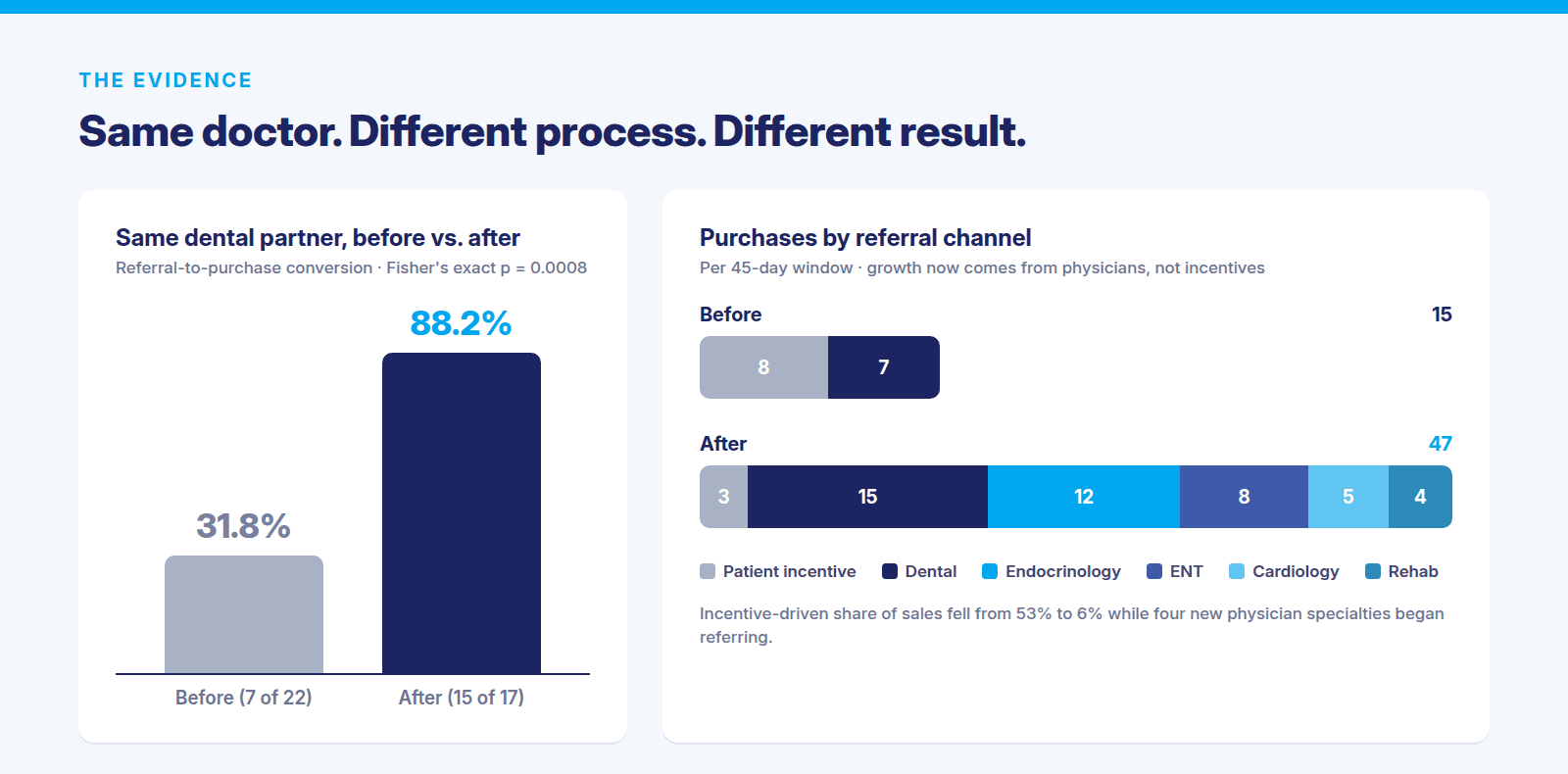
The most revealing comparison came from the one relationship that stayed constant: the same dental referral partner, before and after. Because the partner didn't change, it gave us a relatively controlled view of whether the process itself was the problem. In the baseline, that partner's referrals converted at just 31.8%.
The Improvements
Each solution was tied directly to a validated root cause. Nothing was added because it sounded good.
A structured post-diagnosis consultation and follow-up process
Pre-test patient engagement, so therapy is introduced as part of care from the start
A re-capture pathway for patients referred out for higher-level testing
A single system of record, with daily data entry as a policy, not a preference
Formal policies and standard procedures where none had existed
Dedicated physician outreach capacity: two field representatives, recruited and matched to the role
A structured, three-week training program for the representatives and the clinic team
How the Work Was Divided
A redesign like this is part systems, part clinical, and part fieldwork. No single person should carry all three.
I led the operational and systems side: configuring the system of record, designing the end-to-end process, and writing the policies and procedures that make it enforceable. I recruited the field representatives and matched candidates to the role. I also built the marketing materials and outreach tactics, and trained the team on the why behind every step, including the legal and compliance implications of how patient information and referrals are handled. People follow a process far more consistently when they understand the reasoning, not just the rules. Much of that design was shaped by live field findings from our onsite team, which kept every policy anchored in reality.
Llean Joie Bautista led the clinical foundation: sleep and airway anatomy, the clinical picture behind a diagnosis, and the knowledge the team needs to speak credibly with physicians and patients. That grounding is what makes a representative trustworthy in a physician's office rather than just persistent.
Kris Salumbides, BSc, RPSGT, our President and Co-Founder, led the onsite work in Canada. Beyond hands-on device training, the physician pitch, and live doctor visits alongside the new representatives, he ran a live problem assessment on the ground: observing how the clinic actually operated day to day and where patients and referrals were slipping through. Those field findings fed directly into the policies and processes I was building, so every procedure was grounded in what was really happening in the clinic, not what we assumed was happening.
Systems, clinical credibility, and field presence. Remove any one of them and the results below don't happen.
The Results
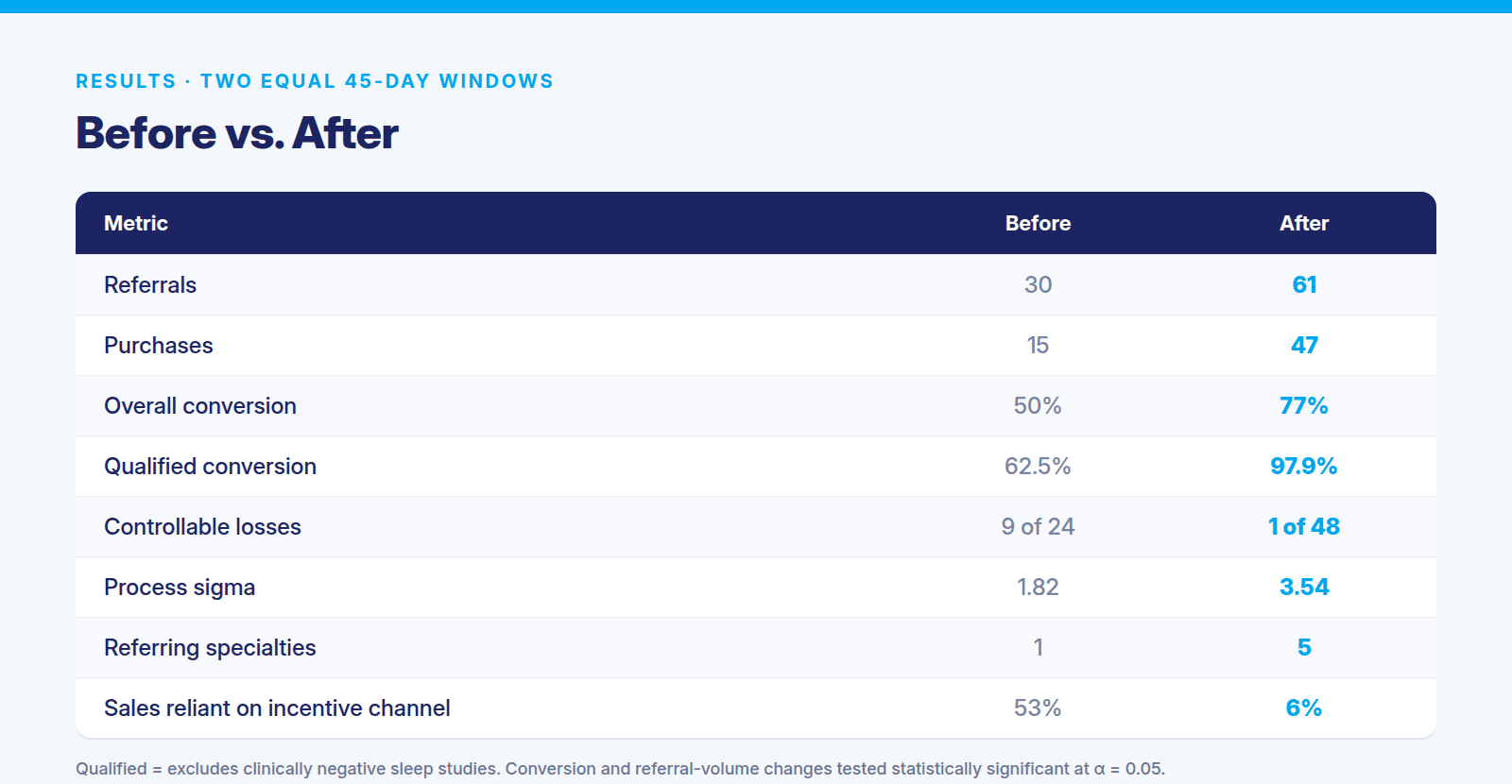
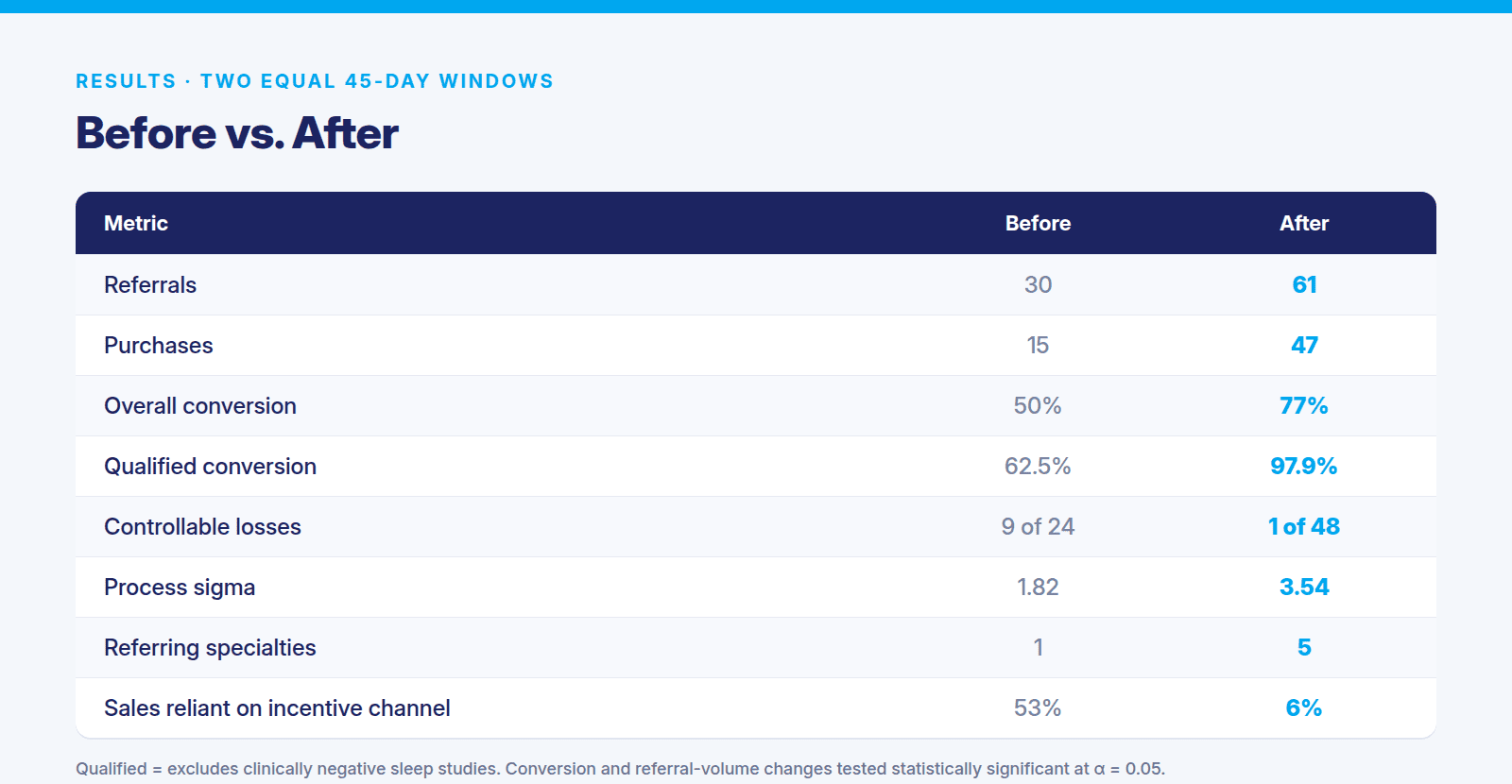
In the post-intervention 45-day window, purchases rose from 15 to 47, overall conversion from 50% to 77%, and qualified conversion from 62.5% to 97.9%. Controllable losses fell from 9 of 24 qualified referrals to 1 of 48. Process sigma moved from 1.82 to 3.54.
The growth came from both sides of the fix. The clinic went from one referring specialty to five, and the four new specialties contributed 29 of the 47 purchases. Meanwhile, a tighter process meant almost none of those new patients were lost along the way. Reliance on the incentive channel fell from 53% of sales to 6%.
And the controlled comparison: the same dental partner's conversion rose from 31.8% to 88.2%, a statistically significant improvement. Same referrer, different process.
That single comparison is the lesson of the whole project. The partner didn't change. The process did.
What I Would Tell Any Healthcare Leader
1. Fix the leak before you pour in more water. Acquisition matters. This clinic needed new referral sources too. But growth poured into a leaking process just produces more lost patients. Seal the leak first, then scale.
2. Separate what you control from what you don't. Clinically appropriate outcomes are not defects. A metric that punishes teams for good clinical judgment will eventually corrupt it.
3. Trust is a process, not a personality. Physicians refer where their patients are cared for consistently. Consistency comes from systems, not effort alone.
4. Teach the reasoning, not just the rules. Policies without rationale get followed until someone is busy. Policies people understand get followed when no one is watching.
5. One good window is not the finish line. The project is now in its stabilization period. We're monitoring performance weekly, building control charts as data accumulates, and stratifying results by specialty and referral source, so that one strong channel can't hide a weakening one. Physician trust takes months to mature. Sustaining the gain is the real work.
Why This Matters to Me
I'm a nurse. I've spent more than a decade in sleep medicine and healthcare operations, and I've seen how often good clinics lose patients not because care is poor, but because the path to care is broken.
Lean Six Sigma gave me the language and the tools to prove where that path breaks, and to fix it with evidence rather than assumptions. It took me two years to complete my Black Belt, working through it alongside live operations and real life. This project is the reason I'm glad I finished.
I'm grateful to the clinic's owners and staff, who were willing to look honestly at their own data and change how they work. That willingness is the one thing no methodology can supply.
Healthcare doesn't need more people who work harder inside broken processes. It needs more people who can see the process, measure it, and redesign it with clarity, data, and compassion.
That's the work we intend to keep doing.
Client details have been anonymized. Results reflect two equal 45-day measurement windows; the project continues through its planned stabilization period.